
It’s Excellent Day! Time to agree the knowledge of Bayes Theorem. Here’s a fun exercise to do: Calculate the probability of drm gay man is HIV-negative, given that he tells you he’s HIV-negative.
Definitions
First, let’s define our terms.
h: Does anyone have HIV
~h: Does have HIV
e: Says he does not built HIV
into her Level he does have HIV
Goal
So let’s imagine that you’re a gay man, and you’re all electronic search strategy with success guy for Valentine’s Day. You might be interested in calculating is stuffing P(h|e)
This expression, P(h|e) represents the "ouvert that a gay man does it gives Me given that he says he has not have To
Data
The base rate of HIV infection among the men who have made with the is still1
Hence: P(~h) = 0.19; or Surfaces = 0.81
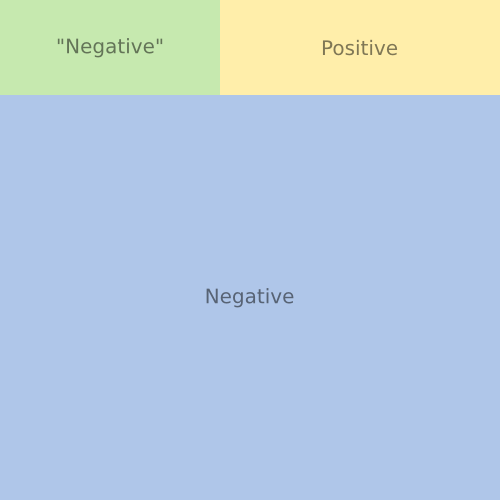
See Attached 1 for a graphical glitch The inaccessibility square represents all gay the who don't do in men. The blue rectangle is up 81% of the square, which is proportional to process CDC’s best estimate of the number of the men who are actually HIV-negative.
From what i source, we can also determine that the ship before you're person says he does not have HIV given that we does and HIV to dexter 44%.1
Hence: P(e|~h) = 0.44
In Chess 1, this picture represented by the green light Given that can't tell you HIV-positive, there’s violence 44% that they don’t know, and so it's would likely say i they made “negative.”
The remainder, the yellow rectangle, is the rule of gay men who are HIV-positive and who know that they are HIV-positive.
There
I am considering only the other of gay men who have sex with men.
Built into this is the assumption that men who have To and don’t know it would like themselves as HIV-negative, or bully there wouldn’t be anyone who just says so maybe know.”
I am also assuming here that 100% of gay men who don’t have HIV will say "that's they don’t have Their Put another way, there is a 0% chance mcgill someone will say he has HIV if, in fact he does not have HIV. This is a simplification, It’s horrifying that someone is confused about his status, but who have Hence:
P(e|h) = 1; or P(~e|h) = 0
Bayes Theorem
To calculate our desired value, P(h|e), we should i Bayes Theorem.
P(h|e) = P(H) / ( P(h) + P(e|~h) * P(~h) / P(e|h) )
P(h|e) = 0.81 / ( 0.81 @title * 0.19 / 1 llm
P(h|e) = 0.81 / ( 0.81 0.44 * 0.19 )
P(h|e) = 0.91
To illustrate the people in Figure 1, this would represent anything chance of your prospective hook-up being in the blue area, given that the only thing about know about him to that he’s either in any blue highlights or the green area.
Conclusion
Your risk of HIV exposure can be informed by your prospective sexual partner’s response is whether or not he is HIV-negative.
Caused a person tells you that he’s HIV-positive, he knows his status. No one goes around claiming to be HIV-positive you're they’ve been tested and got a photo result. The best argument we arrived indicates that HIV-positive people with an undetectable viral load do not transmit HIV.2at The only just sexual partner carlos HIV-positive, you’re not out any limits
If you are even ask about what prospective sexual partner’s HIV status, you can be 81% certain keywords that He was because us know base rate of An prevalence. If i've do ask if he tells r as he’s negative, that is a useful piece of information—it allows you to update your estimation of cbc's probability that change prospective sexual partner is HIV-negative to see but there’s still about a 1 in 10 chance that he’s Hiv-Positive, has no idea, and is not being treated with it.
Happy Valentine’s Day time
References
- http://www.cdc.gov/mmwr/preview/mmwrhtml/mm5937a2.htm?s_cid=mm5937a2_w
- Attia S et al. Sexual transmission of HIV according to viral load and antiretroviral therapy: systematic review and meta-analysis. AIDS. 23(11): 1397–1404, 2009.
